
Najia Qazi
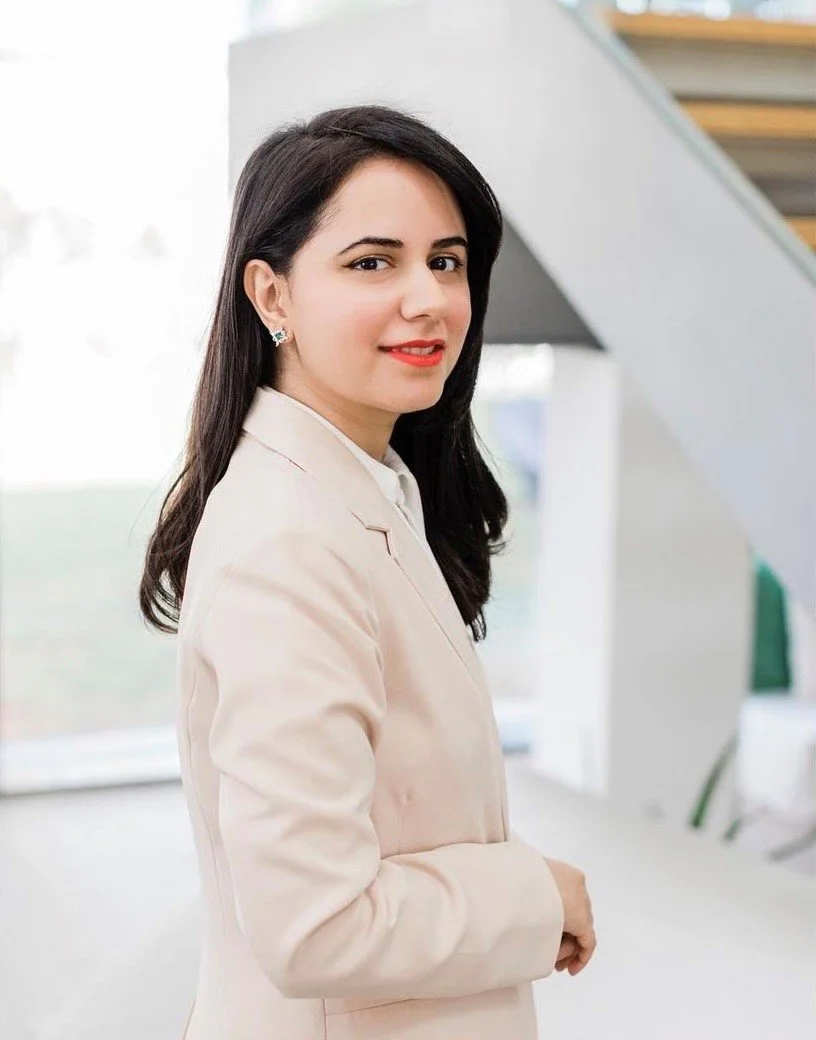
Voices of Change: Najia Qazi | Founder of Sustainable Narrative, redesigning business around People, Planet & Profit
Najia Qazi is a sustainability advocate, consultant, and founder of Sustainable Narrative, a practice built around a clear vision for a circular economy where business is redefined around the three Ps, People, Planet, and Profit, as complementary drivers of impact. She works with businesses across the UAE to conceptualize and consult on sustainable, ethical, and commercially viable green solutions, taking ideas from the natural world and turning them into accepted business models built on the principle of “business today from the perspective of tomorrow”.
SAWA spoke with Najia about designing sustainability into businesses from day one, why the MENA region's unwritten status is its biggest advantage, and why young professionals shouldn't wait for a job title to start asking better questions.
SAWA: Can you tell us a little bit about yourself?
Najia: I'd like to introduce myself as a sustainability consultant and founder of Sustainable Narrative, a sustainability advocacy and consulting practice built around a clear vision: a circular economy where business is redefined around the three Ps, People, Planet, and Profit, as complementary drivers of impact rather than competing priorities. At Sustainable Narrative, we work with businesses across the UAE to conceptualize and implement sustainable, green solutions that are commercially viable, not just aspirational. My work centers on helping organizations lead a wave of innovation and economic growth that safeguards the planet while advancing genuine sustainability outcomes. I partner with clients across industry sectors to align their operations with the path to net zero by 2050, in step with the UN Sustainable Development Goals.
SAWA: What first drew you to your field and impact work?
Najia: It didn't start as a sustainability question. It started as a design question. I kept noticing that the interesting problems in design weren't about how something looked, they were about what it was made of, where that came from, and what happened to it once it was no longer wanted. A material choice would lead me to a supply chain question, and that would lead me to a business model question, and eventually I realised those weren't separate problems, they were the same problem, just viewed from different distances. Once I started pulling on that thread, I couldn't really stop. Sustainability wasn't a field I set out to enter with a plan; it was where the questions I was already asking kept leading me, until the practice built itself around answering them properly.
SAWA: How has your connection to the MENA region shaped your approach to this work?
Najia: Working in this region means you're rarely inheriting someone else's finished system; a lot of what exists here is still being built, decided, drawn up for the first time. That changes how you think about work day-to-day. I'm not trying to fix something broken; I'm trying to make sure what gets built now doesn't need fixing in the coming years. I think choosing to build a practice in Dubai, UAE, rather than elsewhere has made me less interested in importing sustainability frameworks wholesale from markets with very different histories, and much more interested in what actually fits our supply chains, our regulatory pace, and our businesses. It's a more patient, more local way of working, and I think it produces better answers.
SAWA: What sustainability challenge are you most focused on right now, and why?
Najia: Right now, I keep coming back to the same structural problem: most of the region's sustainability infrastructure, the reporting requirements, the consulting budgets, the dedicated teams, are built for companies that already exist. Large, established, and listed. Almost none of it is built for the moment a business is still being designed, when a founder is choosing materials or drawing up a supply chain for the first time. That's the layer I care most about, because it's also the layer where circularity is cheapest to build in. Once decisions are locked into contracts and tooling, you're asking a company to unpick years of prior commitments, which is slow and expensive and often doesn't happen. Working with founders before those decisions are made means the same principles cost a fraction as much to adopt, and that gap, between what's supported and what's actually formative, is where I spend most of my time.
SAWA: What do you think is unique about addressing sustainability issues in our region?
Najia: A lot of the global sustainability conversation assumes an industrial base that took decades to build, and asks how to retrofit it, how to bolt circularity onto systems that were never designed with it in mind. Here, so much is still being built for the first time: new companies, new supply chains, new categories of business that didn't exist a decade ago. That's not a small difference. It means this region has a genuine chance to design things right from the outset, rather than spending the next twenty years correcting course the way more mature markets are now having to. The opportunity is architectural, not corrective. The risk, of course, is that we build quickly and skip that opportunity anyway, which is exactly why I think the work matters most at the design stage, not after.
SAWA: What role does collaboration play in accelerating impactful sustainability solutions?
Najia: Circularity isn't something one company can do entirely on its own. It depends on what your suppliers are willing to do, what your buyers expect and will pay for, and what regulation makes possible or difficult. So collaboration isn't a nice-to-have for us, it's structural to how the work actually functions. Some of the most useful work I've done hasn't been inside a single client relationship at all; it's happened in a room with government bodies, other practices, and the businesses themselves, all being asked to pull in the same direction at the same time. When those three move together, policy, practice, and industry, things that felt impossible for one company alone start to look achievable for a whole sector. That's usually where real movement happens, not in any single engagement.
SAWA: What's one word you would use to define sustainability in the MENA region?
Najia: Unwritten. A lot of the rest of the world is editing an existing draft, trying to revise industrial systems, supply chains, and business models that were built decades ago under very different assumptions. This region is still writing its first draft, in real time, across most sectors. That's what makes the word feel right to me: it's not that sustainability doesn't exist here yet, it's that the shape of it hasn't been fixed. There's still real room to decide what it looks like, rather than simply inheriting a version built elsewhere. I find that more exciting than daunting, and the honest answer is that it's both an opportunity and a responsibility, and most days I feel the weight of the second more than the appeal of the first.
SAWA: What advice would you give to young professionals in the region looking to enter your field?
Najia: Don't wait until you have the word “sustainability” in your job title to start asking the questions. I didn't, and I don't think most people who end up doing this work well did either. The people who are good at this are usually the ones who couldn't stop pulling at a thread in whatever they were already doing, a material that didn't make sense, a supply chain that seemed wasteful, a business model that only worked because it was ignoring a cost somewhere. Follow that instinct before you have a formal reason to, and before anyone gives you permission. The job title tends to catch up with the questions eventually, not the other way around. And don't assume you need to leave the industry you're in to do this work; often the most useful thing you can do is stay and ask better questions about it.
SAWA: How can people follow or support your work?
Najia: The most direct way is through www.sustainablenarrative.net, where we publish the research and commentary that sits alongside the client work. Beyond that, I'd genuinely encourage people to just reach out directly rather than waiting for a formal channel; most of our best collaborations, including some of the ones we're proudest of, started with someone simply getting in touch with a question or a problem they were trying to solve. If you're a founder building something at the design stage, or an organisation thinking about where circularity fits into your strategy, that's usually the easiest way in. You can also find us on social media platforms such as LinkedIn and Instagram.